





Reframing our Regulatory Relationship with Aboriginal and Torres Strait Island local governments
Waste management
Between 2014 – 2019, the department’s Environmental Services and Regulation (ESR) Division implemented a compliance program specific to Aboriginal and Torres Strait Island local governments across Cape York and the Torres Straits. The program included 76 individual waste and sewage facilities geographically dispersed across approximately 518,000 square kilometres.
The program was based on the department’s Regulatory Strategy and Enforcement Guidelines. It aligns with standard compliance programs delivered across the industry. Compliance data accumulated during the program identified two significant indicators of effectiveness:
- Traditional regulatory approaches aligned with the Regulatory Strategy and Enforcement Guidelines did not lead to significant or lasting improvements in compliance, quality of life, or environmental impact.
- In contrast, collaborative engagement at various government levels achieved measurable improvements in environmental performance and improved human health and wellbeing
A new regulatory approach
In response to this program, ESR identified the value of further investigation and project design to develop and implement an innovative structure for working with First Nations communities.
In 2020, ESR invested in a small project team to engage with all 17 of Queensland’s Aboriginal and Torres Strait Islander local governments. The aim was to develop a regulatory approach that is relationship-based rather than transactional and embodies the principles of the Gurra Gurra Framework.
In partnership with Aboriginal and Torres Strait Islander local governments, the team developed a co-designed pathway for the environmental regulator to improve its regulatory relationship with Indigenous local governments and map the critical steps to developing relationships based on connection and support.
This pathway allowed ESR to move forward, acknowledging that some restrictions, e.g. remoteness or availability of resources and equipment, are genuine and that place-based, fit-for-purpose solutions must be tailored to the community’s needs.
The Environmental Services Support Program
ESR established the Aboriginal and Torres Strait Island Local Governments Environmental Services Support Program (ESSP) in mid-2022. Its primary focus is establishing relationships and delivering co-designed services through an improved service delivery model.
The improved service delivery model aims to:
- take a place-based approach
- understand and work through challenges related to the operation of the council’s environmentally-relevant activities (primarily sewage treatment and landfill operations)
- facilitate the development and implementation of opportunities to support local capability-building
- provide fit-for-purpose and fit-for-place advice and guidance about operational performance, planning and grant opportunities
- connect supporting partners to enable a holistic approach to delivering improved services.
A sustainable waste strategy for First Nations communities
Specific to waste management, the ESSP supports the implementation of the Respecting Country – A sustainable waste strategy for First Nations communities and lifts the profile of why waste management is a critical service in communities. Particularly given some of the genuine and unique challenges communities face, which have and do impact on environmental and cultural values. Some of the challenges faced by communities include:
- land tenure, management and access rights, coupled with no or limited revenue base
- waste impacts on cultural and environmental values and community health and wellbeing
- landfill capacity constraints, such as lack of access to daily cover material and legacy and bulky waste issues
- waste transportation issues, including costs, logistics, and biosecurity zoning, severely impacting opportunities for resource recovery
- remote, discrete communities with weather-dependent access and significant travel distances between communities and regional centres
- grants-based funding dependency and the lack of ongoing operational and maintenance funding for critical infrastructure
- access to readily serviceable plant and equipment
- limited access to training and development opportunities
- the attraction and retention of suitably qualified staff.
Funding and support
Since 2022, the ESSP has supported five Indigenous local governments receiving over $6.5 million collectively through the Queensland Government’s Recycling and Jobs Fund to support waste management and resource recovery initiatives in their communities. In addition, eight Indigenous councils successfully obtained grant funding through the Local Government Illegal Dumping Partnership Program (Round 2B). ESSP works collaboratively with this program to support councils addressing the impacts of littering and illegal dumping in and around their communities.
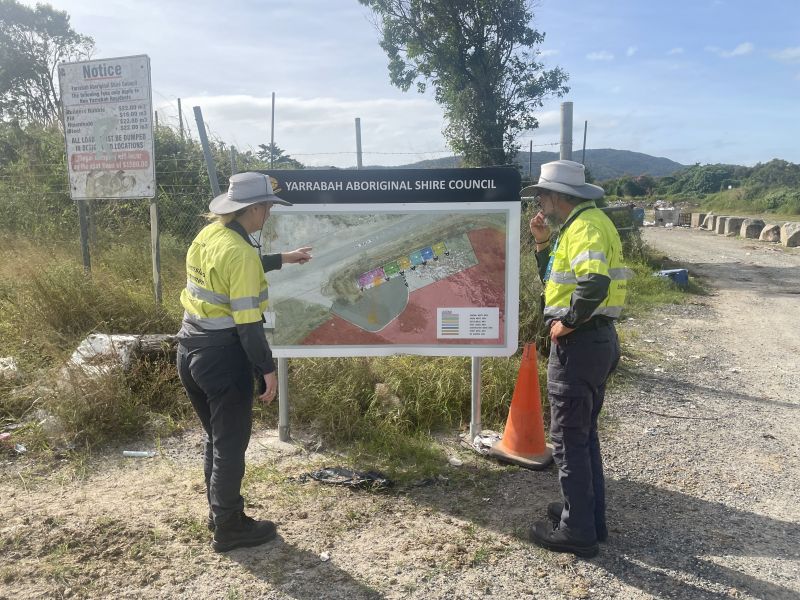
By the end of 2023, the ESSP had undertaken 63 community visits to support Queensland’s Aboriginal and Torres Strait Island local governments with progressing their aspirations to improve the environmental performance of their waste and wastewater infrastructure.
The ESSP will continue to work closely with councils to develop waste management solutions that are fit for purpose and place while honouring the cultural and custodial relationship these communities have with land, sea and sky.
 © Queensland Government