Overview
The following information is drawn from the Great Barrier Reef Outlook Report 2024 (Outlook Report).
The Great Barrier Reef remains whole and intact and maintains many elements that make up its outstanding universal value, as recognised in its World Heritage listing. Since it was inscribed as a World Heritage Area in 1981, significant components that underpin its four natural World Heritage criteria have deteriorated.
The size of the World Heritage Area is becoming a less effective buffer against the global impacts of human-induced climate change, which continues to challenge its integrity. Without additional national and global action to tackle the greatest threats to the Great Barrier Reef through this critical decade and beyond, the protective capacity of size will continue to be eroded by persistent and broadscale impacts on the Region and adjacent areas. The effectiveness of local and regional-scale management actions is ultimately impacted by the success of actions to address external influencing factors, such as climate change.
World Heritage criteria
Natural beauty and natural phenomena
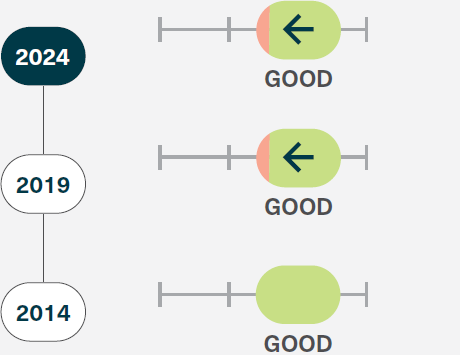
Taken as a whole, the Region’s natural beauty and natural phenomena endure. Iconic species, such as humpback whales, show signs of recovery, but some land and seascapes have deteriorated. Since 2019, some species and populations of marine turtles, southern regions of seagrass meadows, and potentially coral diversity in some locations, have declined, resulting in the condition of this component being good (borderline poor). Much of the evidence for this grade is inferred from the assessments in the Outlook Report’s Chapters 2 and 3.
Major stages of Earth's evolutionary history
The modern Great Barrier Reef remains a rich geological repository for records of the Earth’s recent evolutionary history. Understanding of this history has continued to advance since 2019. Over the coming century, the geomorphological resilience of coral reefs will be under increasing pressure due to rising sea temperatures and ocean acidification. Despite the broader trajectory toward degradation, key processes have remained stable since 2019.
Ecological and biological processes
At a Region-wide scale, ecosystem processes continue functioning, and many have remained stable since 2019. Overall, the size and diversity of the property mean that many processes (e.g. recruitment, predation, and particle feeding) show no consistent trend.
Habitats for conservation of biodiversity
While the condition of some values has shown improvement, others have declined since 2019. The property’s size continues to buffer the effects of human-induced climate change, but scale is not an infinite buffer to persistent broad-scale impacts on the Region.
Assessment summary
See the links below the table for the Great Barrier Reef Outlook Report 2024’s full assessment information and methods.