

Gondwana Rainforests protection and management
The Gondwana Rainforests of Australia is a World Heritage site comprised of 41 New South Wales and Queensland national parks and reserves, ranging in size from 10 to 102,712 hectares.
Each areas conserve different attributes of the site's Outstanding Universal Value (OUA) and faces diverse threats. While their management has effectively addressed the challenges so far, further management responses will be required to address increasing threats, particularly those posed by wildfires, invasive species, pathogens, and climate change.
The Gondwana Rainforests of Australia Conservation Outlook Assessments from 2014, 2017 and 2020 outline the area’s protection and management effectiveness. Outlook Assessment reporting has changed from every three to every five years, with the next due in 2025.
The State of Conservation of the Gondwana Rainforests of Australia Report was prepared in 2020 and 2022, and updated in 2023 in response to the World Heritage Committee’s request for an assessment of the impacts of the 2019-2020 bushfires. The most recent report was published in December 2024. These reports detail the monitoring and recovery actions taken to protect and manage the Gondwana Rainforests’ OUV.
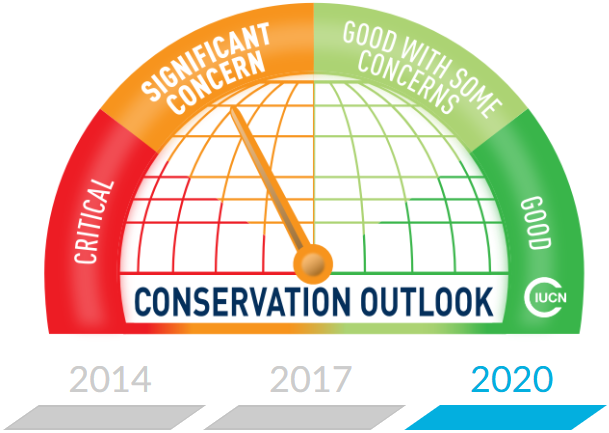
2020 Conservation outlook
Significant concern
A significant management challenge occurred in the Australian spring and summer of 2019-2020, when a prolonged drought, exacerbated by record-breaking temperatures and rainfall deficits, culminated in extensive and severe wildfires.
Management responses to this catastrophic event were considerable and ongoing. However, given the severe nature and extent of the fires, even the significant resources and hazard reduction burns conducted in the previous autumn and winter seasons were ineffective.
There are several government inquiries into the fires’ causes and responses. The fires dramatically changed the conservation outlook for the Gondwana Rainforests of Australia. Whether the natural ecosystems and ecological functions are sufficiently resilient to recover from this previously unexperienced event remains to be seen.
Actions are in place to:
- make rapid assessments of the impact levels
- undertake welfare for threatened species
- limit the impact of invasive predators and weeds
- collect some plants and seeds for future propagation.
There is wide recognition that considerable conservation actions will be required. However, there is the lingering prospect that the catastrophe signals the impact of climate change on weather patterns and that these changes will not be reversed easily.
The Gondwana Rainforests of Australia exist as refuges, where many deep evolutionary lineages persisted during episodes of past climate fluctuations. The conservation management challenge is to support and maintain that resilience into the future.
Overall assessment of protection and management
Mostly effective
The protection and management of the World Heritage site are highly to mostly effective. Given that this is a serial site, whether all the components are adequately buffered and connected as possible has been questioned.
The Gondwana Rainforests of Australia (an extension to the existing World Heritage site) is on Australia’s Tentative List. Extending the site would support enhanced connectivity and better protection of its OUV. While management has effectively addressed the main challenges so far, additional resources to support further management responses will be required to address the ongoing decline in key values and potentially increasing threats, particularly those posed by wildfires, invasive species and pathogens, and climate change.
Assessment of the effectiveness of protection and management in addressing threats outside the site
Mostly effective
More information is required to understand protection and management effectiveness outside the site. Many of the site’s reserves are buffered by additional protected areas, but not all of them. Many of the adjacent areas are managed as national parks and state forests. There is a relatively high level of threat management in these areas. Environmental law in Australia has a strong approach to threat management, and there is an acknowledgment that good land management on private and public land requires integrated management, whether for pests or fires. Undoubtedly, this can be improved, which is a consistent challenge for all land managers, especially in the face of climate change predictions.
Results
| Gondwana Rainforest assessment of protection and management and trends | 2014 | 2017 | 2020 |
|---|---|---|---|
Overall inside | Mostly effective | Mostly effective | Mostly effective |
Overall outside | Data deficient | Data deficient | Mostly effective |
Management system | Mostly effective | Highly effective | Highly effective |
Effectiveness of management system | Highly effective | Mostly effective | Mostly effective |
Boundaries | Some concern | Some concerns | Some concerns |
Integration into regional and national planning systems | Highly effective | Highly effective | |
Relationships with local people | Data deficient | Data deficient | Mostly effective |
Legal framework | Highly effective | Highly effective | Highly effective |
Law enforcement | Highly effective | Highly effective | Highly effective |
Implementation of Committee decisions and recommendations | Mostly effective | Mostly effective | Mostly effective |
Sustainable use | Data deficient | Data deficient | Data deficient |
Sustainable finance | Mostly effective | Mostly effective | Mostly effective |
Staff capacity, training, and development | Data deficient | Data deficient | Mostly effective |
Education and interpretation programs | Highly effective | Highly effective | Mostly effective |
Tourism and visitation management | Highly effective | Highly effective | Mostly effective |
Monitoring | Mostly effective | Mostly effective | Some concerns |
Research | Highly effective | Highly effective | Highly effective |
More information:
- Gondwana Rainforests of Australia | World Heritage Outlook
- Gondwana Rainforests of Australia State of Conservation Update — April 2020
- Additional information on the state of conservation of the Gondwana Rainforests of Australia - key updates 1 February 2021
- State Party Report on the state of conservation of the Gondwana Rainforests of Australia
- State Party Report on the state of conservation of the Gondwana Rainforests of Australia 2024