Threat assessment
The assessment of threats is outlined in the Gondwana Rainforests of Australia Conservation Outlook Assessment from 2014, 2017 and 2020. Reporting of Outlook Assessment has changed from every three years to every five years and the next report is due in 2025.
Fire extent mapping
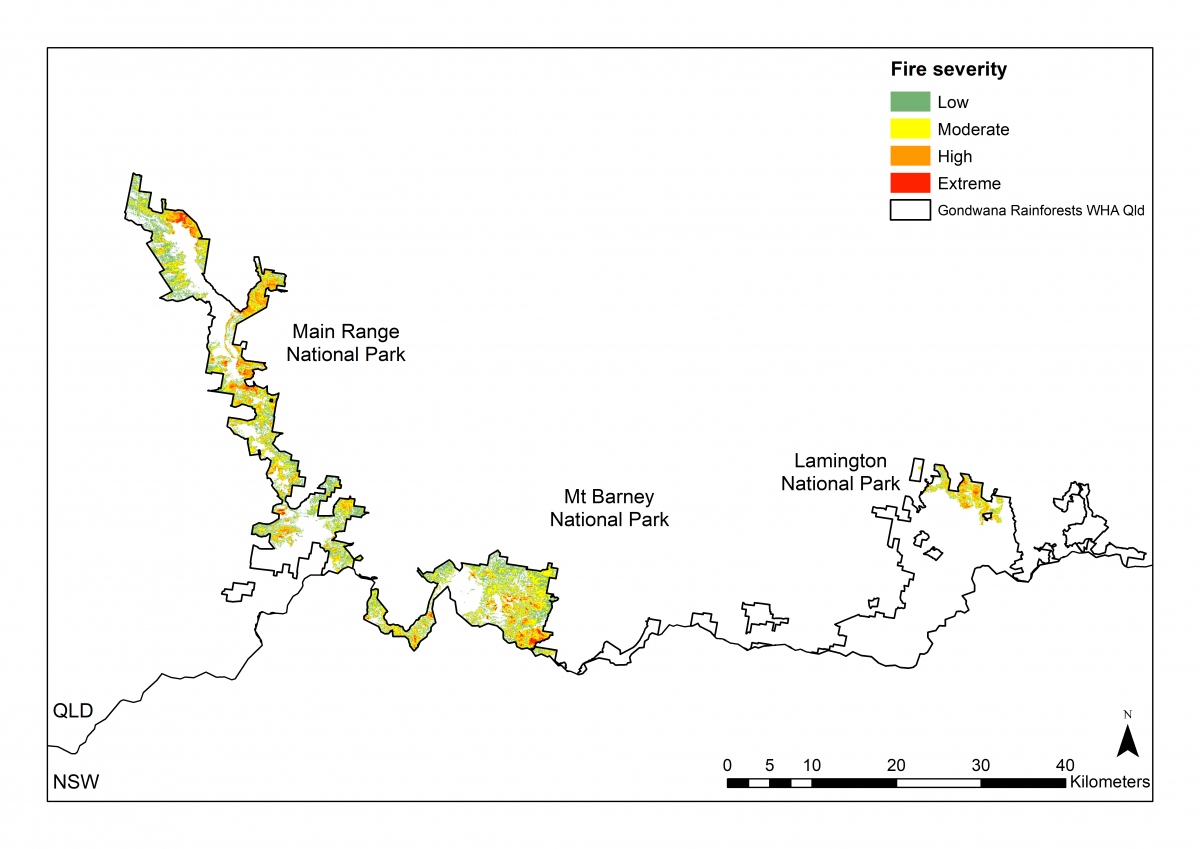
For the Queensland Section, the 2019-20 bushfires impacted approximately:
- 34% or 20,023 hectares
- 3,856 hectares of rainforest
- 13% of the total rainforest distribution within the Queensland Sections.
Fire extent mapping produced for the Gondwana Rainforests of Australia (Queensland Sections) immediately after the fire contained inherent inaccuracies regarding the extent of the burn area. Validated fire severity mapping has since corrected this inaccuracy. The improved bushfire mapping has reduced the area assessed as impacted by the 2019–20 bushfires reported in the previous Queensland State of Environment report.
There has not been any significant bushfire activity at the site since 2019-20.
State of Conversation updates
Responding to concerns about the 2019–20 bushfire impacts, UNESCO’s World Heritage Committee (the Committee) requested a State of Conservation (SoC) update for the Gondwana Rainforests.
The Australian Government has submitted several updates for the SoC on bushfire recovery efforts. The Committee’s decision acknowledged the ongoing collaborative efforts in post-fire monitoring and recovery actions while expressing its utmost concern about the negative impacts of the 2019-20 bushfires on the attributes of the property’s Outstanding Universal Value (Decision 45 COM 7B.79 at the 45th session).
Recovery after the fires
While some areas of the property and particular plant and animal species appear to be recovering, some areas experienced high to catastrophic ecological impacts from the fires.
The Queensland Government continues to work with the Australian Government on post-fire recovery actions, including:
- controlling pests and weeds
- restoring landscapes
- repairing and maintaining infrastructure
- monitoring the recovery of species and ecosystems.
In the Queensland Section, we are taking additional action, including:
- reviewing the forward planned burn programs considering the 2019-20 fire impacts and actions to protect unburnt refuge areas from subsequent fire
- controlling ecosystem-transforming species to reduce their impact on the recovery of priority ecosystems and species
- targeting feral animals who are a priority for control, e.g. fencing to exclude cattle entry.
Monitoring and research
We continually monitor the recovery of areas and species, including those needing additional research to identify the impacts of fire and climate change. We must also develop comprehensive recovery actions and adaptive management strategies.
This threat is considered high.
Conservation outlook results
| Threat | 2014 Status | 2014 Location | 2017 Status | 2017 Location | 2020 Status | 2020 Location |
|---|---|---|---|---|---|---|
Fire / Fire suppression | Low threat | Inside site, scattered (5-15%) Outside site | Low threat | Inside Outside | High threat | Inside site, throughout (>50%) Outside site |